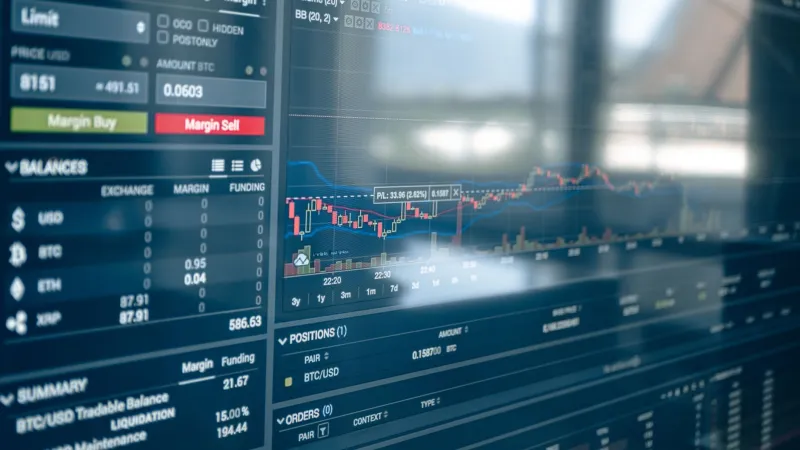
You're Already Late: The Infrastructure Gap That Makes Retail Crypto Gamers Sitting Ducks During Volatility Spikes

You've felt it before. Bitcoin moves 8% in 20 minutes. Your group chat lights up. Someone says this is the moment. You jump onto your platform of choice, adjust your positions, and try to ride the wave.
And then — nothing. Or worse, the wave crashes on you specifically. You got in at the peak without knowing it, and by the time your transaction confirmed, the window had already closed.
This isn't bad luck. It's architecture. And understanding why it keeps happening is one of the most important things any serious US crypto gamer can do for their long-term results.
The Volatility Window Is Smaller Than You Think
Let's start with the timeline reality. When a significant price movement happens in crypto — whether it's a macro event, a whale transaction, a regulatory announcement, or a derivatives cascade — the actionable window for exploiting that volatility is measured in seconds to low single-digit minutes.
By the time the movement shows up on your price chart, the initial spike has already been processed by algorithmic systems operating at microsecond speeds. By the time your group chat reacts, the first wave of institutional repositioning is complete. By the time you open your browser, log in, and initiate a transaction, you are not early. You are, at best, mid-wave — and more often than not, you're buying the top of a move that's already reversing.
This isn't cynicism. It's a mechanical reality of how information propagates through crypto markets.
Blockchain Confirmation Times: The Wall You Can't Climb
Here's the part that most retail players don't fully internalize: the blockchain itself introduces latency that no amount of fast internet or quick reflexes can overcome.
On Ethereum, even in normal conditions, transaction confirmation takes 12-15 seconds per block. During high-activity periods — exactly the kind of volatility spikes you're trying to exploit — network congestion can push effective confirmation times to several minutes. And if you underpay on gas fees trying to save money, your transaction might not confirm for much longer.
Bitcoin is even slower, with 10-minute average block times making it essentially useless for anything requiring fast execution.
Faster chains like Solana (400ms block times) and Avalanche (sub-second finality) close this gap significantly, but they don't eliminate it. And even on those chains, the time between you initiating a transaction and it reaching final confirmation still creates a window where conditions can change.
For context: institutional players using centralized exchange infrastructure can execute and confirm trades in under 100 milliseconds. The fastest retail blockchain interaction, on the fastest available chain, is still orders of magnitude slower.
The Information Hierarchy Nobody Talks About
Latency isn't just about transaction speed. It starts earlier — at the point of information receipt.
Major institutional players in crypto markets operate with data feeds that are co-located directly with exchange servers. They're receiving price data and order book updates in microseconds. They have dedicated fiber connections, proximity hosting arrangements, and algorithmic systems that can process and react to market signals before a human being could even perceive that something has changed.
Retail players — yes, including sophisticated US crypto gamers who consider themselves serious — are working with data that's already been through multiple layers of aggregation and delay. Your charting platform, your wallet interface, your gaming platform's price oracle — every layer adds latency.
This means that by the time you see a volatility signal worth acting on, you're reacting to information that institutions already acted on. You're not spotting an opportunity. You're seeing the aftermath of one.
How Platforms Inadvertently Make This Worse
Crypto gaming platforms that incorporate live odds or dynamic pricing based on underlying asset volatility have their own latency issues baked in. Most platforms use price oracles — external data feeds that update on a schedule — rather than real-time spot pricing.
Depending on the platform, oracle updates might happen every 30 seconds, every minute, or even less frequently during high congestion. This creates a scenario where the price you're betting on inside the platform is already stale relative to actual market conditions — but not stale in a way that benefits you. Platforms typically build in protections that ensure stale pricing doesn't hurt them. The retail player bears the risk of the lag.
The Volatility Chaser's Actual Track Record
Research into retail trading behavior during high-volatility crypto events consistently shows the same pattern: retail participants who attempt to trade into volatility spikes underperform both passive holders and disciplined non-participants. The combination of late entry, elevated fees during congestion, and emotional decision-making under time pressure produces systematically poor outcomes.
In the context of crypto gaming specifically, volatility spikes often coincide with platform instability — slower load times, delayed transaction processing, and in some cases temporary outages. The worst possible moment to be making rapid decisions is exactly the moment most players feel the urgency to act.
What You Can Actually Do About It
None of this means volatility is meaningless to retail crypto gamers. It means you need to engage with it differently.
Stop trying to trade the spike. Start positioning before it. If you have a thesis about upcoming volatility — a Fed announcement, a major protocol upgrade, a known catalyst — position your gaming bankroll before the event, not during it. You won't capture the exact peak, but you won't arrive after the party either.
Use volatility as a bankroll management signal, not a trading signal. High volatility periods are often better times to pull back on active gaming, preserve your bankroll, and wait for conditions to normalize. The players who protect capital during chaos are the ones who have capital to deploy when clarity returns.
Choose platforms built for speed when speed matters. If you're going to game during volatile conditions, be on chains and platforms with the fastest confirmation infrastructure. Solana-based gaming platforms offer a meaningfully better experience during congestion compared to Ethereum alternatives.
Accept the latency hierarchy and plan around it. You will never have institutional infrastructure. That's fine — you don't need it if you're not trying to compete in the same microsecond game. Build a strategy that doesn't require you to win a race you're structurally set up to lose.
The Real Edge for Retail Players
Here's the honest truth: the retail edge in crypto gaming has never been speed. Institutions will always win the latency race. The retail edge is patience, discipline, and the freedom to choose when and how to play — something algorithms and institutional desks don't have.
At Yes8, betting smart means knowing which battles are worth entering. Chasing volatility spikes against players with microsecond infrastructure isn't bold — it's just expensive. The smart play is to let them fight over the first seconds of every move and focus on the opportunities that actually exist at your level of the game.