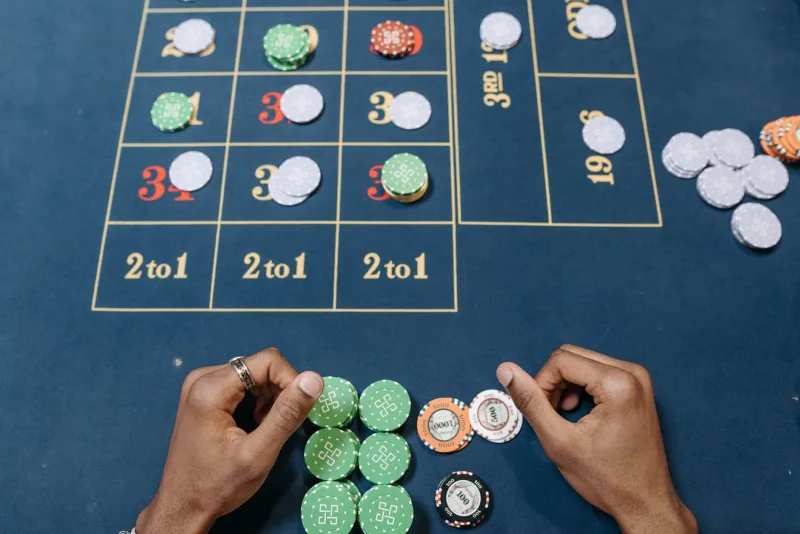
Your Brain Is the Biggest Bet You'll Ever Place: The Psychology Behind Emotional Crypto Wagering

The Leak You're Not Tracking
Most crypto gamers obsess over the numbers — RTP percentages, house edge, token volatility, gas fees. And honestly, that's smart. But there's a cost center that doesn't show up in any dashboard, and it's quietly bleeding out accounts faster than a bad beat streak ever could.
It's your brain.
Not in a self-help, "think positive" kind of way. We're talking about deeply wired behavioral patterns that behavioral economists have documented for decades — patterns that get supercharged when you add crypto's price swings, 24/7 availability, and the dopamine loop of instant wins and losses. Understanding how your mind works against you isn't just interesting. For US crypto gamers, it's the difference between building a sustainable bankroll and watching one disappear session by session without ever knowing why.
Loss Aversion: Why Chasing Feels Logical When It Isn't
Here's a concept from Daniel Kahneman's work on behavioral finance: losses hurt roughly twice as much as equivalent gains feel good. Lose $200 in ETH at a blackjack table, and your brain registers that as dramatically more painful than winning $200 would feel rewarding. That asymmetry has a name — loss aversion — and it's the engine behind one of the most destructive behaviors in crypto gaming: the chase.
When you're down, your brain doesn't say "accept the loss and protect your remaining stack." It says "get it back." And that impulse bypasses rational thinking almost entirely. You start increasing bet sizes to recover faster. You abandon the strategy that was actually working. You tell yourself the next spin, the next hand, the next trade will flip the script.
Here's the hard truth: chasing losses with larger bets doesn't reduce your deficit. It accelerates it. The math doesn't care how badly you want to break even.
The fix isn't willpower. Willpower is a depleting resource, and it runs especially thin when adrenaline is high. The fix is a pre-session rule — written down, not just thought about — that sets a hard stop-loss you commit to before you feel the sting of losing. Treat it like a smart contract. No overrides, no exceptions.
The Winner's Trap: Overconfidence After a Hot Streak
Loss aversion gets all the press, but its mirror image is just as dangerous. After a solid winning session — say you rode a lucky streak on a provably fair crash game and doubled your ETH deposit — something subtle shifts in your decision-making. You start feeling like you've got the read on the game. You loosen your bet sizing. You stay in sessions longer than your original plan called for.
This is the hot-hand fallacy meeting overconfidence bias, and it's a cocktail that gives back winnings at an alarming rate.
Crypto gaming platforms operate on mathematical constants. The house edge doesn't shrink because you're on a run. The RNG doesn't develop a preference for you. What changes is your perception of risk — and that perception, inflated by a few wins, makes you take bets you'd never have considered with a cold head.
A practical countermeasure: set a win ceiling the same way you set a loss floor. When you hit your target profit for a session, you log off. Full stop. This feels almost offensive when you're running hot, but it's exactly the discipline that separates recreational gamblers from people who actually build long-term bankrolls.
Mid-Session Strategy Drift: The Subtle Abandonment
This one's sneakier than chasing or overconfidence. You come into a session with a clear approach — maybe a conservative flat-betting strategy on a low-volatility slot, or a disciplined Martingale boundary on a dice game. Then something happens mid-session that feels like evidence your strategy isn't working. Maybe you hit a cold stretch. Maybe you watch someone else in a live game pull off something flashy.
So you adjust. Just a little. Then a little more. By the end of the session, you're playing a completely different game than you started with, and you can't even trace when the drift began.
Behavioral economists call this "strategy erosion" — and it's driven by present bias, the tendency to overweight what's happening right now relative to your longer-term plan. In crypto gaming specifically, the volatility of token values adds an extra layer. If your ETH is pumping mid-session, your perceived bankroll is growing even if you're not winning, which warps your risk tolerance in real time.
The antidote is documentation. Before each session, write down your strategy, your buy-in, your stop-loss, your win target, and the specific conditions under which you'd consider adjusting your approach. If you feel the urge to deviate mid-session, check that document first. More often than not, the urge doesn't survive contact with your own pre-game logic.
Crypto-Specific Amplifiers: Why Digital Assets Make This Worse
Traditional casino psychology is well-documented. But crypto gaming introduces variables that make emotional betting significantly more volatile.
First, there's the abstraction layer. When you're betting in SOL or BTC rather than dollars, your brain naturally discounts the real-world value — similar to how casino chips reduce the psychological weight of spending cash. You'll take risks with 0.5 SOL that you'd never take with the dollar equivalent sitting in your checking account.
Second, crypto markets run around the clock, and so do most blockchain gaming platforms. There's no closing bell to force a reset. No commute home to decompress. US players especially — used to the rhythm of traditional financial markets — can find themselves in five-hour sessions that started as "just a quick game" because there's no external structure forcing a stop.
Third, token price swings create phantom gains and losses. Your bankroll's dollar value can shift 15% while you're mid-session without a single bet being placed. That moving floor changes how you assess risk in ways that are almost impossible to track consciously.
Building Mental Infrastructure, Not Just Willpower
Here's the reframe that actually works: stop trying to out-discipline your emotions in the moment, and start building systems that make emotional decisions harder to execute.
- Pre-session documentation: Written plan, hard limits, defined strategy. Non-negotiable.
- Session timers: Set a clock before you start. When it goes off, you evaluate with fresh eyes — not mid-adrenaline ones.
- Cooling-off triggers: Identify your personal tilt signals (faster clicking, muttering, increasing bet size quickly) and build a mandatory five-minute break into your routine the moment you notice them.
- Denomination anchoring: Regularly convert your crypto balance to USD equivalent during a session. Keep the real-world value visible so abstraction doesn't distort your risk perception.
- Post-session journaling: Not to beat yourself up, but to spot patterns. If you lost three sessions in a row after a win streak, that's data. Use it.
Play Bold Means Play Smart
At Yes8 Crypto Gaming, bold play doesn't mean reckless play. It means going in with conviction — conviction that comes from preparation, self-awareness, and a strategy that doesn't evaporate the second the pressure rises.
The players who consistently build their crypto stacks aren't the ones with the best luck or the deepest pockets. They're the ones who figured out that the most important game being played in any session isn't on the screen. It's the one happening between their ears.
Get that one right, and everything else becomes a lot more manageable.